

CAT 6A vs CAT 8 for 25G and 40G: A Data Center Copper Cabling Specification Guide
As modern data centers transition to 25GBASE-T and 40GBASE-T Ethernet, selecting the right copper cabling standard is critical for long-term performance, scalability, and return on investment. The decision between CAT 6A and CAT 8 Ethernet cables directly impacts signal integrity, channel reach, thermal performance, and infrastructure longevity.
At Cenfra Telco Systems (CTS), we manufacture high-performance data center copper cabling solutions engineered for electrical precision and reliability. This technical guide compares CAT 6A vs CAT 8 for 25G and 40G deployments, helping IT consultants and network architects specify with confidence.
Understanding 25GBASE-T and 40GBASE-T Over Copper
The IEEE 802.3bq standard defines both:
- 25GBASE-T – 25 Gigabit Ethernet over balanced twisted-pair copper
- 40GBASE-T – 40 Gigabit Ethernet over copper
Both standards are optimized for short-reach operation up to 30 meters, requiring Category 8 cabling to meet full channel compliance.While CAT 6A supports certified 10GBASE-T up to 100 meters, full compliance for 25G and 40G Ethernet over copper is achieved using CAT 8 Ethernet cable operating at 2 GHz.
For consultants designing high-density data centers, reach and bandwidth requirements must align with physical layer specifications.
CAT 6A vs CAT 8: Technical Comparison for Data Center Infrastructure
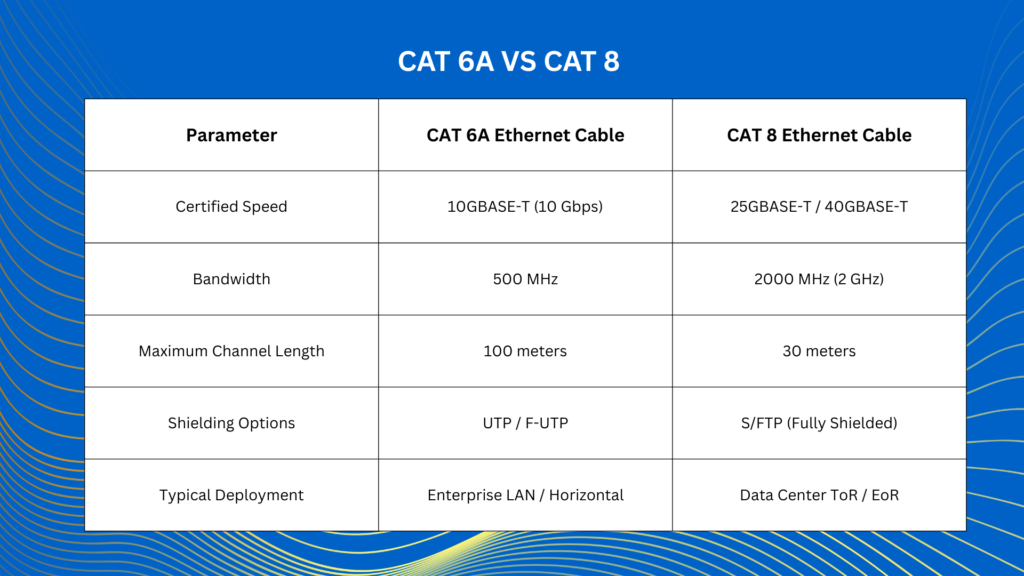
CTS CAT 8 cables are engineered with precision twisting and mandatory shielding to maintain performance integrity in high-density switch-to-server environments.
Channel Reach: 100m vs 30m in 25G and 40G Architectures
CAT 6A Cables for 100 Meter Structured Cabling Stability:
CAT 6A remains the global standard for:
- 10G data center backbone
- Enterprise LAN deployments
- Smart buildings and healthcare facilities
- Campus-wide structured cabling
It provides reach flexibility and cost efficiency for large infrastructure footprints.
CAT 8 Cables Optimized for 25G and 40G Short-Reach:
CAT 8 is purpose-built for:
- 25G Ethernet over copper
- 40G Ethernet RJ45 connectivity
- Top-of-Rack (ToR) architecture
- End-of-Row (EoR) server connectivity
- AI and high-performance computing clusters
The 30-meter limitation ensures signal stability at 2 GHz and is ideal for dense rack deployments.
Thermal Performance in High-Density Data Centers:
In GCC and UAE deployments, elevated ambient temperatures must be considered in structured cabling design.
As temperature increases:
- DC resistance rises
- Insertion loss increases
- Cable bundle heat accumulation intensifies
CTS utilizes optimized conductor sizing (including 22 AWG and 23 AWG copper designs where applicable) to reduce resistance and maintain performance in high-ambient and high-density rack environments.
Thermal headroom is particularly important in:
- AI-driven computing environments
- Hyperscale data centers
- Contained rack systems
Shielding and Installation Considerations:
CAT 6A Cabling
Cat 6A are available in UTP and F/UTP cable variants. It offers easier termination and flexible installation environments.
CAT 8 Cabling
CAT 8 cables require S/FTP construction and grounding and bonding is mandatory. It is designed for EMI-heavy data center environments and also requires higher installation precision.
While CAT 8 introduces added complexity, it delivers superior immunity for 40GBASE-T copper deployments.
Copper vs Fiber for 25G and 40G Infrastructure:
Data centers typically deploy:
- CAT 8 copper cabling for short 25G/40G RJ45 links
- Fiber optics for longer backbone connections
CAT 8 advantages include:
- Familiar RJ45 interface
- No optical transceiver modules required
- Simplified port management
- Reduced complexity in short rack interconnects
Fiber remains preferred for distances beyond 30 meters or for higher-speed future upgrades beyond 40G
Specification Checklist for Consultants
When specifying CAT 6A or CAT 8 for data center infrastructure, you should ensure:
- ANSI/TIA-568.2-E compliance
- ISO/IEC 11801 Class EA or Class I/II compliance
- ETL or UL third-party certification
- LSZH jacket compliance
- Permanent link certification:
- CAT 6A tested to 500 MHz
- CAT 8 tested to 2000 MHz
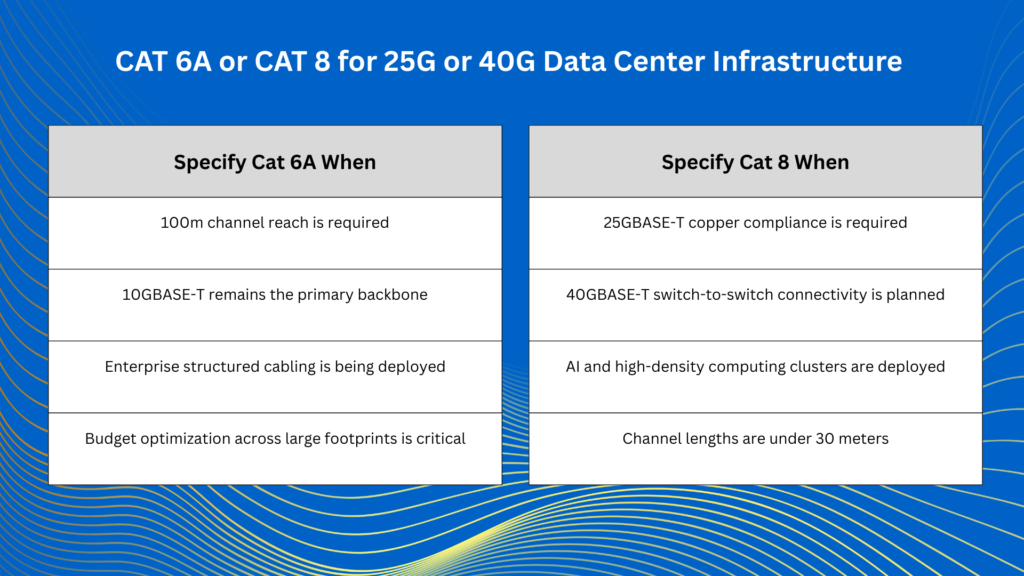
When Should You Specify CAT 6A vs CAT 8 in 25G and 40G Data Centers?
Why CTS CAT 6A and CAT 8 Copper Cables?
Cenfra Telco Systems (CTS) designs structured cabling for high-frequency electrical precision, thermal stability in GCC environments, and verified third-party compliance, ensuring long-term reliability. Our CAT 6A and CAT 8 Ethernet cables support evolving 25G and 40G data center architectures, protecting your infrastructure investment while delivering consistent, future-ready performance.
FAQ section:
1. Is CAT 6A suitable for 25G Ethernet?
CAT 6A is certified for 10GBASE-T up to 100 meters. Full 25GBASE-T compliance typically requires CAT 8 cabling at 30 meters.
2. What cable is required for 40GBASE-T?
40GBASE-T requires Category 8 cabling with 2 GHz bandwidth and a maximum 30-meter channel length.
3. Is CAT 8 better than CAT 6A for data centers?
CAT 8 is better for short-reach 25G and 40G high-density data center links. CAT 6A remains ideal for 10G enterprise deployments with 100-meter reach.